
Inflation
| Economic Growth | Inflation | International Trade | Government Finances | Unemployment |
Inflation
Inflation is the steady and persistent rate of change in the level of prices in an economy. The most common measure of inflation is the Consumer Price Index (CPI) which is the overall change in the prices of goods and services that people typically buy over time. In Ireland, the Central Statistics Office (CSO) collects approximately 53,000 prices every month and compares these to the corresponding prices from the previous month in order to construct the CPI.
Short-term Trends
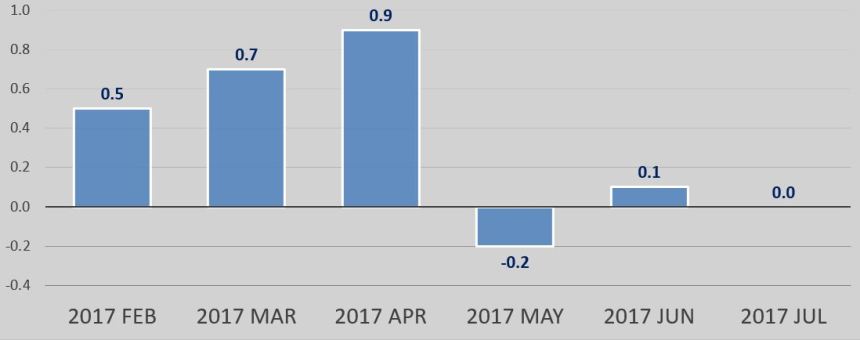
Inflation Rate (% monthly change)
Source: CSO - Consumer Price Index
Long-term Trends
The annual average rate of inflation in 2016 was 0%, compared to -0.3% in 2015 and 0.2% in 2014. Central banks around the world traditionally target inflation rates in order to manage monetary policy, with most targeting a 2% rise for inflation. There has been a slight pickup in inflation rates globally in 2016, for example, 0% in the EU, 1.26% in the US and 0.6% in the UK. A low inflation rate is one of the reasons why many central banks still keep interest rates low in order to increase economic activity.
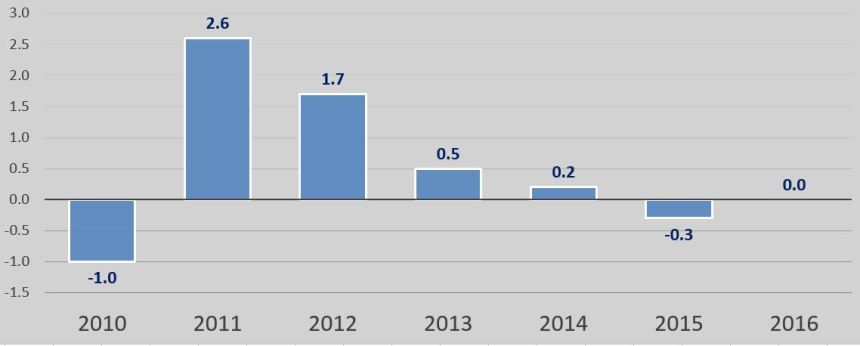
Inflation Rate (% annual change)
Source: CSO - Consumer Price Index
